
How Trout See: Understanding Trout Vision for Better Fishing Success
If you want to consistently catch more trout, understanding how these fish see the world is a huge advantage. Trout rely heavily on their vision to find food, detect predators, and survive in their aquatic environments. Their unique eyesight plays a major role in how they respond to flies, lures, and even your presence on the water. Let’s break it down:
The Trout Color Spectrum: What Colors Do Trout See?
Trout have highly evolved eyes that allow them to see a broad range of colors — and in some ways, their color vision is better than ours.
They can see across the ultraviolet (UV), blue, and green parts of the spectrum extremely well. Scientists believe that trout can detect UV light especially well when they are young, which helps them spot tiny zooplankton and insects. As trout mature, their UV sensitivity decreases slightly, but they still maintain excellent blue and green vision.
Colors in the red-orange range, however, are harder for trout to distinguish, especially in deeper or stained water where these colors fade out first. That’s why brighter or UV-reflective flies and lures are often more effective, particularly in low-light or murky conditions.
✅ Tip: When fishing clear water on bright days, natural greens and blues work great. In darker water or low light, brighter colors with UV reflectivity can trigger more strikes.
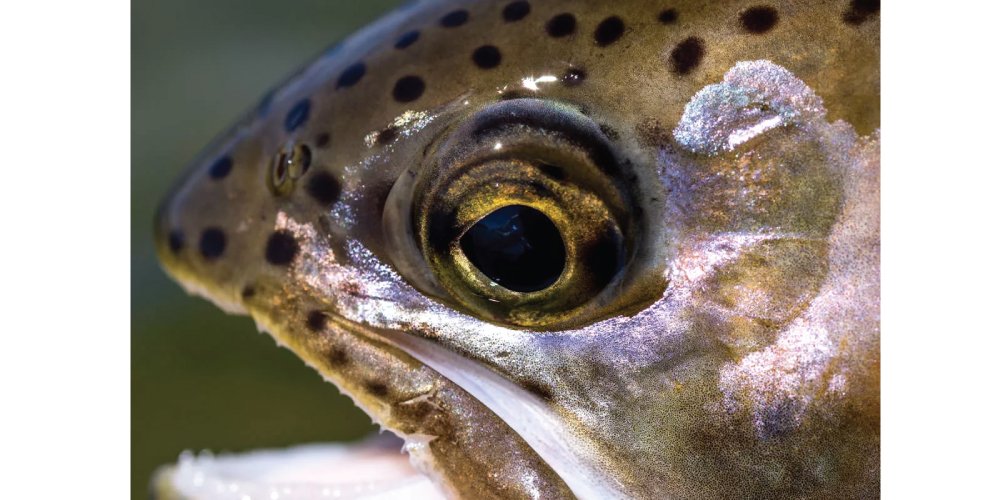
How Trout See
How Trout Perceive Light
Trout eyes are built to function in shifting light conditions.
They have a tapetum lucidum — a reflective layer behind the retina — that enhances their ability to gather light, especially in dim conditions like dawn, dusk, or deep pools.
Their pupils can also adjust quickly, allowing them to handle sudden changes in brightness — from a sunny open stretch of river to a shaded undercut bank.
However, trout are still sensitive to direct, harsh light. Bright, direct sunlight can make them wary, causing them to retreat into deeper water, shade lines, or under rocks and logs.
✅ Tip: Fish low-light periods like early morning, evening, or cloudy days for trout that feel more comfortable feeding actively.
Day vs. Night Vision
During the Day:
In daylight, trout rely heavily on their color vision and sharp detail to spot insects, baitfish, and predators. Clear water and sunlight allow them to pick out subtle movements, so stealth is critical for anglers. Even the flick of a fly line or your silhouette against the sky can spook a wary trout.
At Night:
At night, trout’s vision shifts dramatically. They rely less on color and more on detecting contrast, movement, and silhouettes. Their tapetum lucidum allows them to see surprisingly well in near darkness, but colors lose meaning. A black or dark-colored fly that casts a strong silhouette against the night sky is often more effective than anything flashy.
✅ Tip: When night fishing, use dark streamers or mouse patterns that create strong outlines trout can spot against lighter night skies.
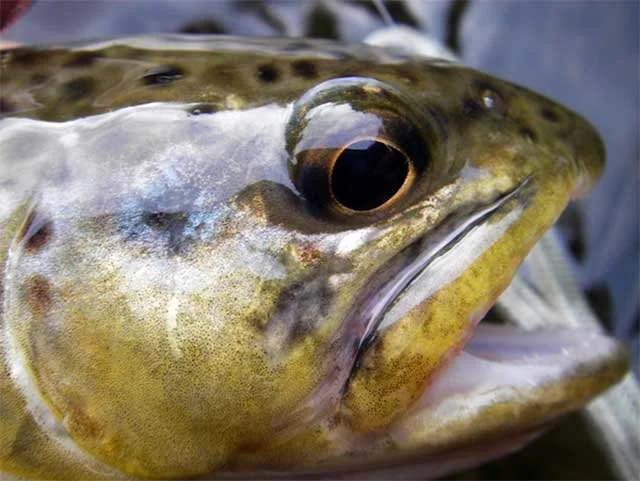
How Trout See
Above Water vs. Below Water: The Trout’s Window
A trout’s view of the world is controlled by the “surface window” — a cone-shaped area of vision caused by the way light bends (refracts) as it passes from air into water.
From below, trout can see a clear, circular window directly above them that covers about a 97° angle. Outside that window, the world becomes a blurry, distorted mirror.
• Above Water: Trout can clearly see things (like birds, bugs, or anglers) directly above them inside that window.
• Below Water: Beneath the surface, they have excellent forward and downward vision. They can detect slight movements, shapes, and shadows — which is why slow, natural fly presentations often outperform fast, flashy ones.
✅ Tip: Stay low, move slowly, and avoid casting shadows across the water when approaching a trout’s holding spot.
✅ Tip: Drift your fly naturally right into their surface window to maximize your chances of a take.
Final Thoughts: How Trout Vision Affects Your Fishing
Understanding how trout see helps you make smarter decisions about:
• Fly and lure color selection (based on light and water clarity)
• Timing your trips (low-light hours can mean better action)
• Your approach and stealth (staying low and hidden)
• Choosing fly patterns (natural drifts by day, bold silhouettes by night)
The next time you hit the water, think about the world from the trout’s point of view — and you might just find yourself hooked up more often.
Thanks for reading this blog post! If you’re a fishing fanatic like me, show your passion by rocking one of the fishing shirts available in my shop. Every purchase helps support my mission to spread the joy of fishing, protect the waters we love, and keep the spirit of the outdoors alive.
Tight lines,
Danny Egan
Egan Fishing
